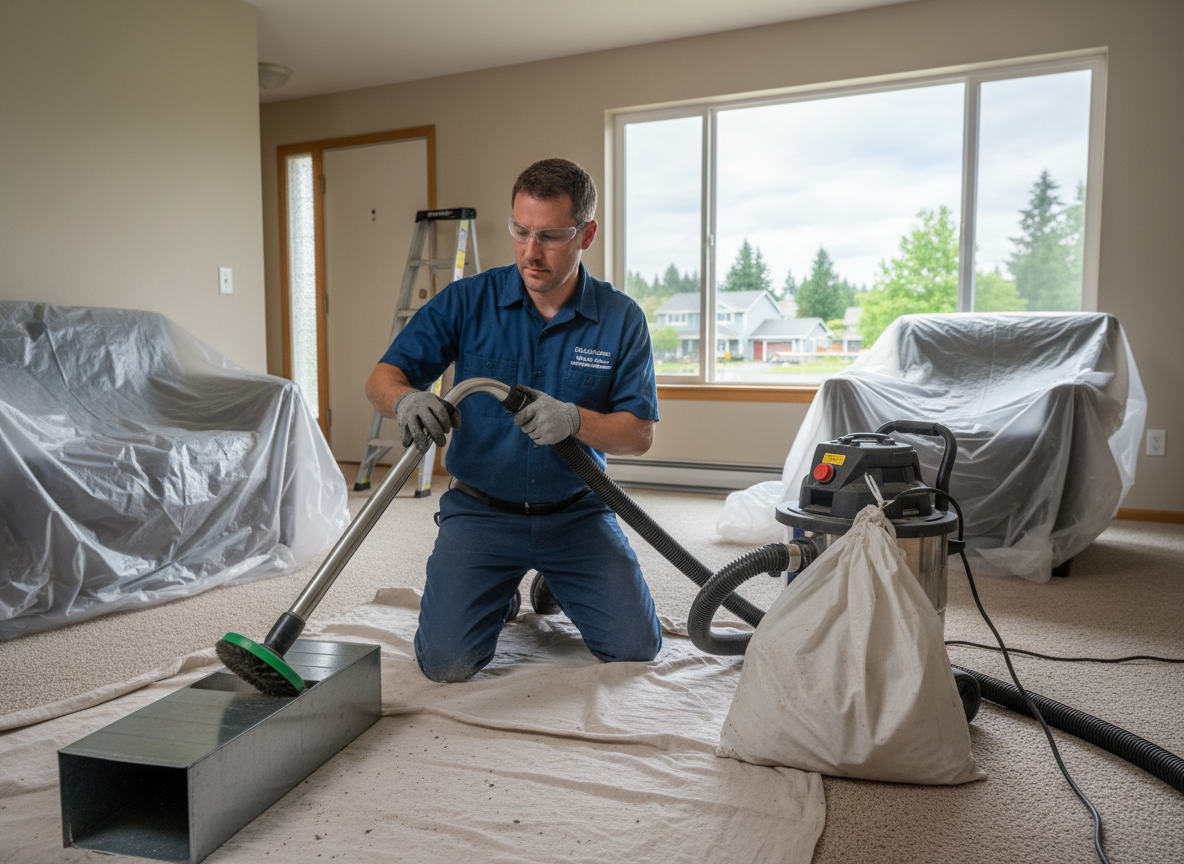
Gresham homes built before the 1980s in Rockwood and around the Gresham Pioneer Cemetery often feature original flex duct runs that trap moisture from the area's frequent winter rains and occasional flooding along low-lying streets near Mt. Hood Community College. These conditions promote dust and mold accumulation inside the lines that standard portable vacuums miss, especially when mild summers allow spores to circulate through single-story ranch layouts common in Multnomah County. Technicians must isolate each branch run and use negative-air machines rated for the extra humidity load rather than relying on basic brushes that can push debris into wall cavities.
Flood events that affect properties near Burnside Road and Downtown Gresham can push fine silt into return plenums when sump pumps or French drains overflow. This sediment hardens over the following dry months and restricts airflow more than typical household dust, requiring low-pressure agitation tools followed by HEPA-filtered extraction to avoid redistributing particles into living spaces. Portland commuters who heat their homes with gas furnaces during the long wet season add another layer of combustion byproducts that settle in horizontal runs, making full trunk-line access points essential for thorough removal.
Terrain changes between the flatter Rockwood grid and the slight grades toward Mt. Hood Community College create cold spots where condensation forms on metal ducts running through unconditioned crawl spaces. Homeowners in these pockets frequently notice musty odors only after the first autumn rains, when the temperature differential spikes. Proper cleaning here includes checking for disconnected joints or crushed sections that trap water, then restoring balanced airflow so the system does not pull additional moisture from the surrounding soil during the next wet cycle.
Technician insight
In Gresham the thing that catches most people out with local air duct cleaning is how wet winters push silt into the low return runs of Rockwood homes near the cemetery; once that material dries during mild summers it hardens and the usual brush heads just skate over it unless you drop the pressure and use a rotary whip first.
Rockwood Return Line Blockage
A homeowner in Rockwood noticed weak airflow after winter rains. Inspection revealed compacted silt in the main return near a low spot that had flooded the previous season. We isolated the run, used low-pressure agitation to loosen the sediment, and extracted it with a HEPA unit before restoring full airflow through the system.
How it works
- 1
Initial Access and Inspection
Technicians arrive at the Gresham address and map every supply and return run, noting moisture stains common after Multnomah County winters.
- 2
Isolation and Containment
Registers are sealed and a negative-air unit is connected at the main trunk to prevent dust migration into living areas during agitation.
- 3
Agitation and Extraction
Rotating brushes and compressed air move debris while HEPA vacuums pull material from the lines, with extra attention to flex sections in older Rockwood homes.
- 4
Final Verification
Each branch is re-inspected with a camera and airflow is checked at registers before the system is returned to normal operation.
Pricing
Upfront quotes based on square footage, number of runs, and any moisture or sediment found during inspection.