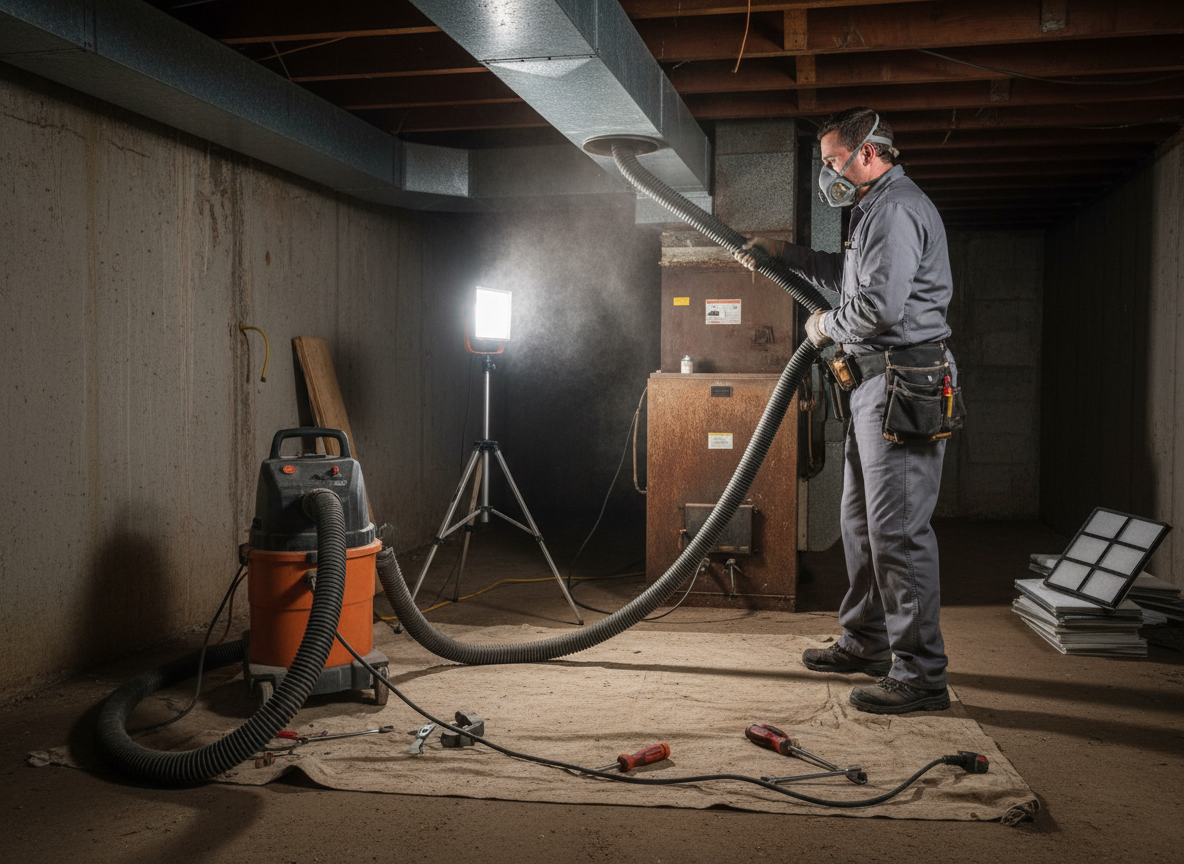
Gresham homes built before the 1980s in Rockwood and Downtown often have rigid metal duct runs with unsealed joints that collect fine silt carried in from mild summer winds off the Columbia. Wet winters bring repeated humidity spikes and occasional floodwater intrusion along low-lying streets near Mt. Hood Community College, creating conditions where dust mixes with moisture and settles deep in the trunk lines. Technicians must pull registers, inspect for standing water stains, and use negative-air machines sized for the longer runs common in these single-story ranch houses rather than the shorter systems found closer to Portland.
Flood events in Multnomah County can push water into crawlspaces under older Gresham properties, leaving behind sediment that later dries into fine powder inside supply ducts. Standard vacuum-only methods miss this material once it cakes on the interior walls of flex runs near the Gresham Pioneer Cemetery area. Proper cleaning requires agitation tools matched to metal versus flex duct, followed by HEPA filtration to prevent redistribution of particles into living spaces during the dry-out phase after winter rains.
Access challenges appear frequently in Gresham because many Downtown and Rockwood homes have finished basements or low crawlspaces that limit equipment placement. Technicians route hoses through exterior dryer vents or attic returns rather than cutting new openings, then verify airflow restoration at each register before leaving the site. This step-by-step verification prevents callbacks when homeowners later notice uneven heating during the first cold snap after service.
Seasonal Moisture Considerations
Wet winters in Gresham increase the chance of condensation inside supply ducts when mild days follow heavy rain. Homeowners in Rockwood should schedule inspections before the first freeze to catch early corrosion at joints near the furnace.
Technician insight
In Gresham, the thing that catches most people out with HVAC duct cleaning is how wet winters push moisture into crawlspaces under Rockwood homes, turning ordinary dust into a paste that standard brushes cannot lift without first addressing the water source near the foundation.
Rockwood Crawlspace Buildup
Heavy winter rain had allowed water to reach the crawlspace under a 1970s Rockwood house. Inspection showed sediment coating the supply ducts near the furnace. Negative-air extraction combined with targeted agitation removed the dried material. Airflow returned evenly and the homeowner reported no musty odors after the next rain cycle.
How it works
- 1
Initial System Inspection
Technician maps all accessible duct runs in the Gresham home, checking for water stains from winter flooding and noting flex versus rigid sections.
- 2
Register and Vent Removal
All registers are removed and labeled, then the system is isolated to prevent cross-contamination between zones in multi-story Rockwood houses.
- 3
Agitation and Negative-Air Extraction
Mechanical agitation loosens debris while a HEPA negative-air unit pulls material out through the main trunk, sized for longer runs typical near Mt. Hood Community College.
- 4
Post-Cleaning Airflow Verification
Each register is tested for restored airflow and the system is reassembled, with notes on any remaining access limitations common in older Downtown homes.
Pricing
Upfront quotes based on number of runs, access difficulty in crawlspaces, and whether flex duct sections require extra time in Gresham homes.