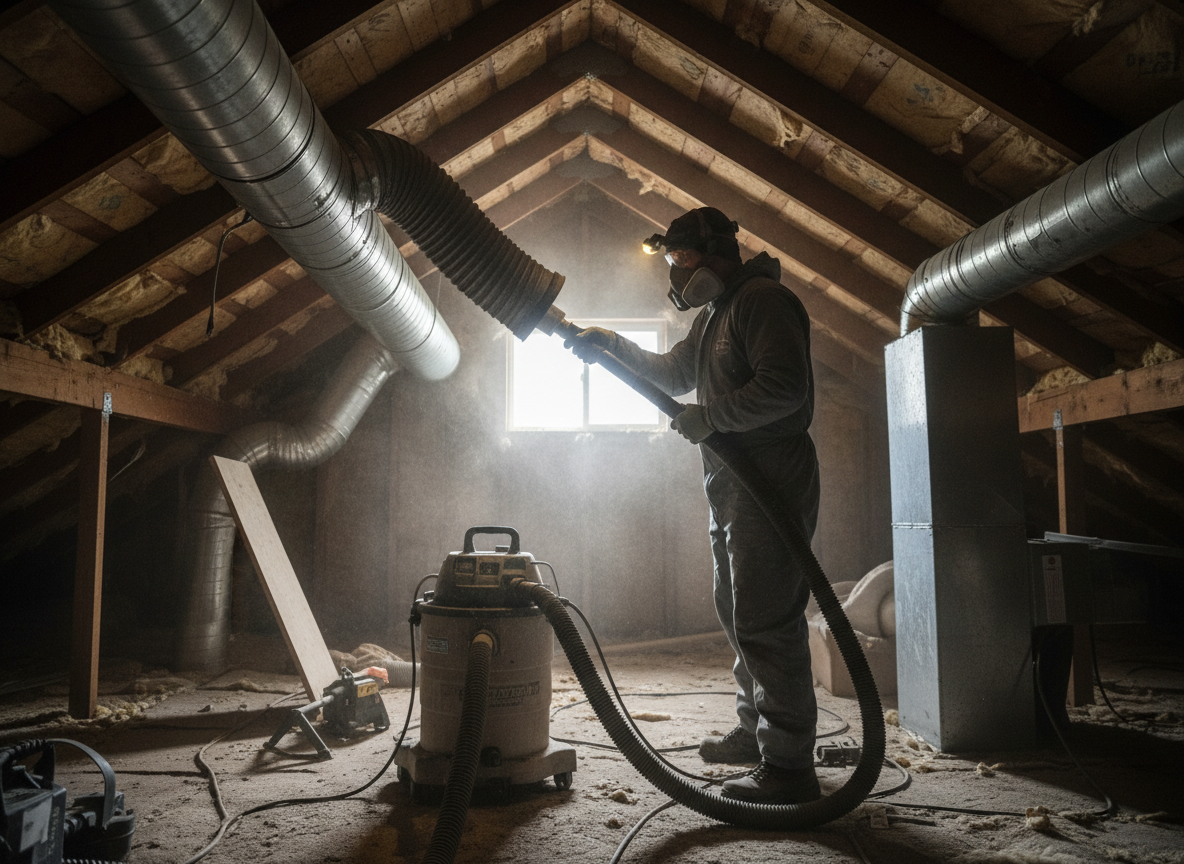
Gresham homes built before the 1980s in Rockwood and Downtown often have attic duct runs that sit directly on ceiling joists with minimal insulation. Wet winters bring repeated condensation cycles, and occasional flooding in low spots near the Gresham Pioneer Cemetery can push humidity upward through ceiling penetrations. Over time this leaves a film of dust and microbial growth inside the ducts that standard floor-level cleaning cannot reach.
Mild summers reduce the urgency for cooling but do not dry out the attic spaces the way drier climates would. Homeowners near Mt. Hood Community College frequently report musty odors that start only after the first heavy rains of November. Accessing these ducts requires temporary removal of insulation batts and careful sealing afterward so that blown-in cellulose does not sift into living spaces below.
Portland commuters who live in Multnomah County often run continuous bathroom and kitchen exhaust fans that pull conditioned air through the attic ducts. When those ducts leak, the system works harder and pulls outdoor moisture back in during storms. A proper attic cleaning includes negative-pressure vacuuming from the attic side, followed by sealing joints with mastic rather than tape that fails in repeated wet-dry cycles.
Technician insight
In Gresham, the thing that catches most people out with attic duct cleaning is how wet winters drive condensation into uninsulated ductwork in older Rockwood homes, turning a simple dust job into a mold remediation once you open the attic.
Rockwood Attic After November Rains
A homeowner near Rockwood noticed a persistent musty smell only after the first heavy rains. We accessed the attic and found standing condensation along the supply trunk that ran above a bedroom addition. We vacuumed the ducts under negative pressure, sealed the leaking joints with mastic, and added insulation blankets over the affected sections. The odor disappeared and the system no longer pulled humid air during storms.
How it works
- 1
Attic Access and Safety Setup
We enter through existing scuttle holes or gable vents, lay down temporary walk boards, and isolate the work area so insulation does not migrate into the house.
- 2
Negative-Pressure Vacuuming
A high-volume vacuum is connected at the main trunk while brushes and air whips agitate debris inside each branch run, pulling material outward rather than pushing it into rooms.
- 3
Moisture Inspection and Sealing
We check for condensation stains and wet insulation, then seal accessible joints with mastic and replace or add insulation where attic access has left gaps.
- 4
Final Airflow and Odor Check
Registers are opened and closed one at a time while the system runs to confirm balanced airflow and that musty smells have been removed.
Pricing
Upfront quotes based on number of runs, attic access difficulty, and extent of moisture staining.